Suri’s story
The fourteen-year partnership that started The Service Paw Project.
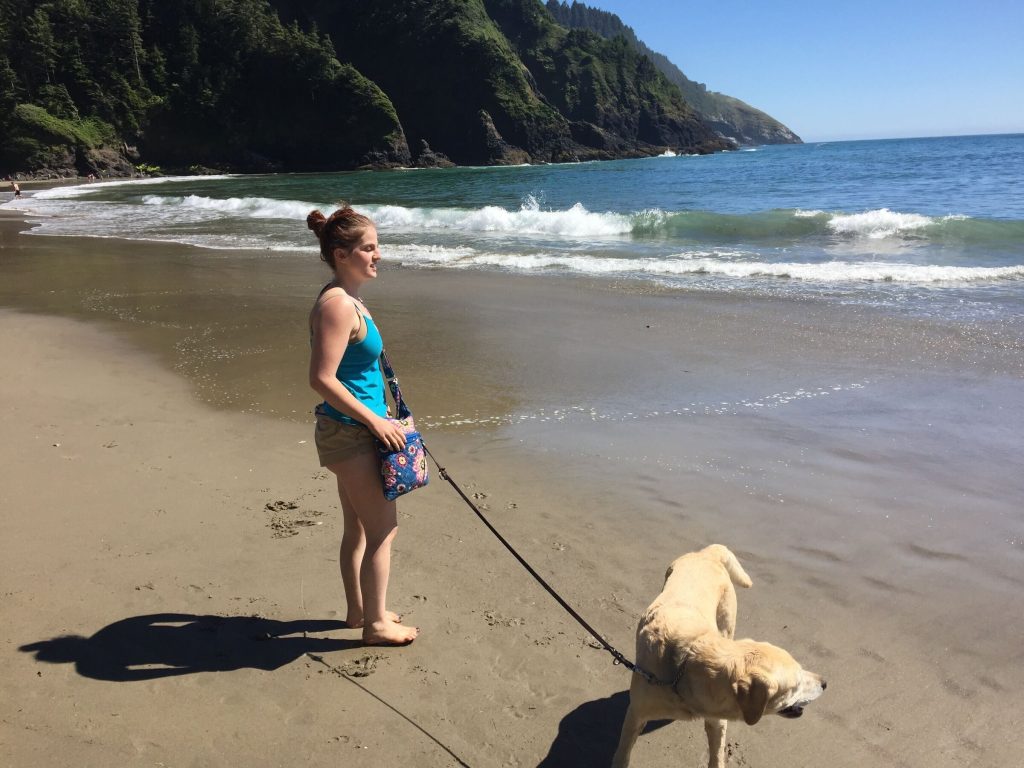
Suri was not a gentle little inspirational movie dog.
She was stubborn. Opinionated. Dramatic. Sometimes her top lip would get caught on her top teeth so she looked like she was half-snarling at the world—pure accidental menace, zero actual threat. The kind of dog who could file a complaint with management using nothing but a look.
She pulled like a freight train when she decided we were too far behind the strangers in front of us—who we were not actually trying to follow. If my pace was unacceptable to her personally, she informed me immediately. Sometimes she’d stop, plant her feet, and give me that lip-caught “snarl” face like, Really? This is what we’re doing today? Then she’d lean into her harness and drag us forward anyway.
She loved trails, cold air, movement, road trips, live music—especially applause—and being involved in absolutely everything. She hated when I practiced singing. She would groan. (And I’m not bad at singing, I swear.) But if I had her on stage with me and a song ended, she’d try to run straight into the crowd that was clapping—fully convinced it was for her.
Unless it was swimming.
Swimming—unfortunately for her—was my sport.
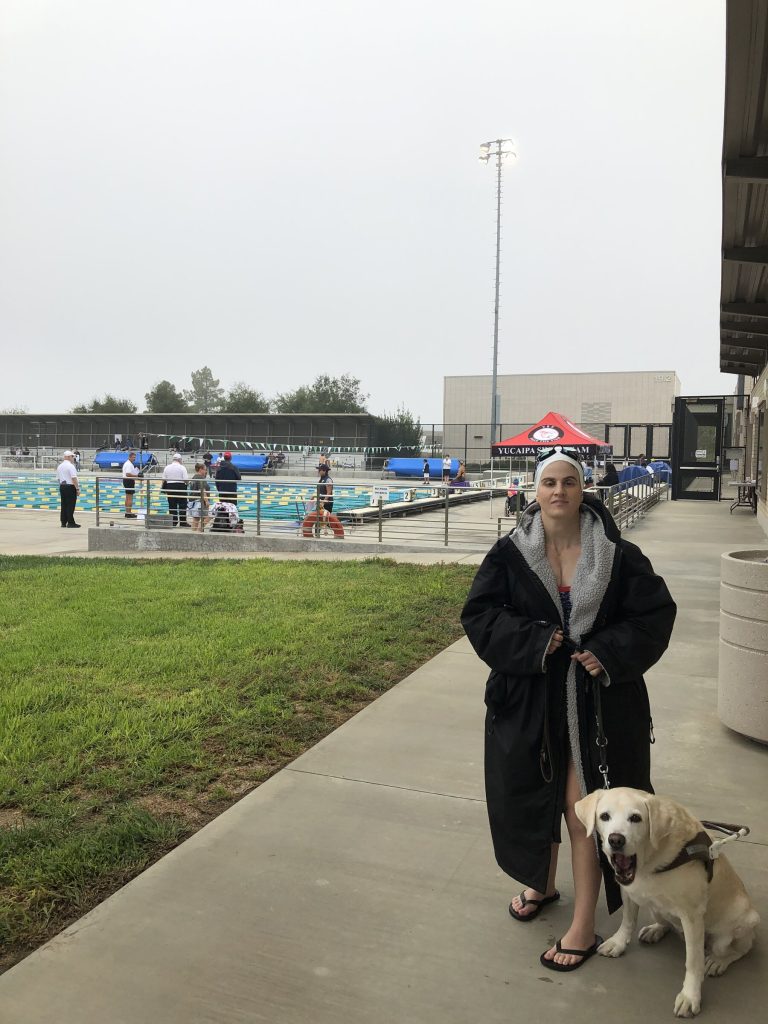
I trained for the Paralympics as an endurance athlete for years, primarily in swimming, and Suri hated pool decks with the fiery passion of someone forced to attend a mandatory corporate seminar against her will. Cycling? Fine. Running? Great. Hiking unreasonable distances? Best day ever. But if I reached for my cap and goggles, she acted like I’d personally betrayed her. She would whine while I was in the water as if I’d abandoned her in a hostile environment full of chlorine and poor life choices.
Which honestly made her more lovable, not less.
She didn’t like me at first
The first week I had her, she didn’t even like me.
She was unimpressed. Skeptical. Like she’d been assigned a new coworker and immediately decided I was unqualified.
And then a friend had a medical emergency. I came back to the room shaken, and I cried on her—like, really cried. She let me. She didn’t pull away. She didn’t get weird. She just stayed.
After that… she liked me.
Even in the “official” moments, she was never the polished, perfectly composed guide dog people imagine.
At graduation, the other Guide Dogs were so together—heads high, strutting onto the stage with their beautiful guide-dog seriousness. And Suri? Suri was pulling everywhere (on leash, technically), doing the lip thing, acting like she was there for a totally different event.
My mom leaned over and whispered, “We got the only weird one.”
She wasn’t wrong.
She wasn’t a mascot. She was my partner.
And still—Suri wasn’t a mascot. She wasn’t a symbol. She was my partner through almost my entire adult life.
She was with me through my twenties into my mid-thirties. Through relationships, career changes, training cycles, injuries, travel, grief, growth, terrible apartments, beautiful moments, and all the ordinary days in between that actually make up a life. When you have a service dog for that long, they stop feeling separate from your identity. Your routines braid together. Your nervous systems learn each other. You stop moving through the world alone—even when it’s quiet.
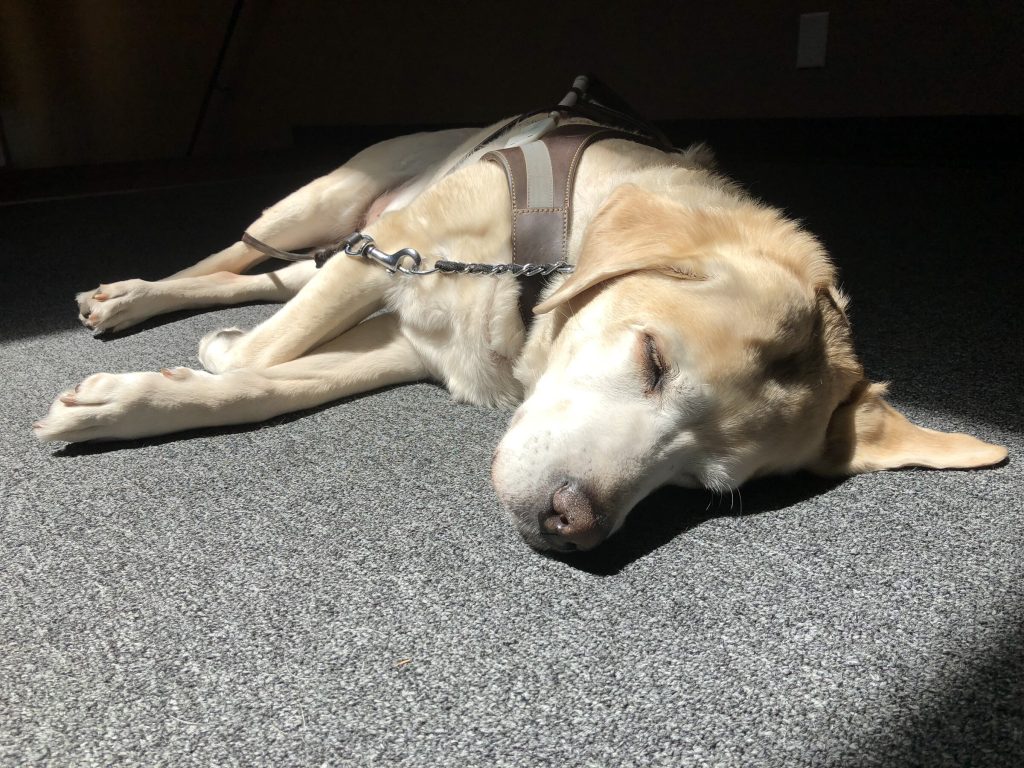
I knew from the sound of her getting up whether she was stiff. I knew from the way she moved beside me whether something was bothering her physically before anyone else would notice. There are details that don’t sound important until you realize they’re the whole point: her paws smelled like cornflakes. I have no explanation for it. It was just… her.
Her paws smelled like cornflakes. I have no explanation for it. It was just… her.
She also knew when I was overwhelmed before I did. In crowds, she’d press her shoulder into my leg—just enough pressure to pull me back into my body—then guide us through like it was nothing. When she tucked her head into my hand for a second—softest head on earth, despite how hardheaded she was—it felt like being reminded, wordlessly, that we were a team.
I started seeing her like an athlete
And here’s the part that took me a long time to name:
We ask extraordinary things from service dogs while often providing them with the bare minimum support structure to sustain that work long-term.
We ask extraordinary things from service dogs while often providing them with the bare minimum support structure to sustain that work long-term.
Athletes talk constantly about recovery—conditioning, inflammation, nutrition, injury prevention, mobility work, rest cycles. Entire industries exist around preserving the bodies of people whose work is physically demanding.
Service dogs have physically demanding jobs every single day too.
The difference is that they can’t advocate for themselves, and they can’t simply “take a week off,” because their handler still needs to cross streets safely, get to work, navigate airports, grocery stores, sidewalks, train stations—life.
At first, I didn’t have big language for any of this. I was just doing what a lot of handlers do: patching things together however I could.
I found a veterinarian willing to work with me on payment plans. I leaned heavily on a holistic vet I trusted. I researched nutrition obsessively. I spent money I probably should not have spent. I learned about recovery and preventative support because waiting until a service dog fully breaks down before helping them seemed insane. I started paying attention to small changes the way I did in sport—because small changes are never actually small for long.
And maybe I saw it sooner because sports had already taught me how fragile longevity really is.
At the Paralympic level, nobody expects elite athletes to survive on neglect and good intentions. Recovery is part of training. Preventing injury is part of performance. You learn to catch tiny signs before they become catastrophic.
So I started looking at Suri the same way.
Not as “a dog getting old.”
As a working athlete whose ability to safely continue her job depended on proactive care.
Around that same time, I had an opportunity that would’ve required me to move to Seattle for work. On paper, it was the responsible decision—career growth, stability, the kind of thing you’re supposed to say yes to.
But Suri was struggling more by then, and I couldn’t bring myself to uproot her life while she needed consistency, treatment, and support. People who haven’t had service dogs sometimes misunderstand this part. They think it’s “just” attachment.
It wasn’t.
My independence and her wellbeing were completely intertwined. The cost wasn’t only money. It was choices. It was what I said yes to. It was what I walked away from.
Why The Service Paw Project exists
And the more I looked around, the more obvious it became that handlers were quietly carrying enormous financial and emotional burdens trying to keep these dogs healthy—with very little systemic support.
Ryan—who I met through work during that season—started seeing the pattern alongside me. He helped me step back enough to realize this wasn’t just my personal struggle or me being “extra” about my dog.
There was a genuine gap here.
Not because people didn’t care. But because most systems still aren’t built around service dogs as long-term working athletes—with proactive conditioning, recovery support, and longevity planning treated as standard, not optional.
Suri worked for 14 years as a guide dog—longer than many programs expect a dog to work safely.
And she died at 15 and a half not in catastrophic decline, not after years of her body completely failing her, but healthy, loved, cared for, and still deeply herself almost until the very end.
She died at 15 and a half — not in catastrophic decline, not after years of her body completely failing her, but healthy, loved, cared for, and still deeply herself almost until the very end.
That matters to me.
Because not every handler can access the patchwork support system I was lucky enough to build around her. Not everyone knows a vet willing to be flexible. Not everyone has a background that taught them to think proactively about conditioning, recovery, nutrition, and longevity. Not everyone can absorb the financial impact of trying to do everything “right.”
But service dogs deserve that level of care anyway.
They give people freedom. Mobility. Safety. Entire careers. Entire lives.
And if we truly value what these dogs do, then we should build structures that value their long-term health too.
That’s why The Service Paw Project exists.
Not because Suri was perfect.
Because she wasn’t. She was weird and bossy and brave and brilliant—and she gave me a life I could not have had without her.
This project is my way of saying: that kind of partnership deserves better support than luck, patchwork, and financial panic.
If you’re here because you loved a working dog, needed one, trained one, relied on one, or simply believe they deserve more than “thank you for your service”—you’re in the right place.
Help service dogs live longer, healthier, working lives.
Every donation funds the veterinary care and nutrition that keeps a service dog working — and a handler independent.